Smart motorcycle diagnostics are no longer only for high-end race bikes or dealership service departments. In 2026, many motorcycles rely on electronic systems that control braking, fueling, ignition, throttle response, traction, charging, and rider safety features. When something goes wrong, guessing is expensive. A warning light, rough idle, weak throttle response, or intermittent electrical issue can have several possible causes, and the wrong repair can waste time and money.
Modern riders expect more from their motorcycles. Street riders want reliability. Track riders want clean power delivery. Micro Sprint racers want precise setup and repeatable performance. Even used motorcycle buyers want to know what is happening inside the bike before committing to a purchase. That is why diagnostics matter. The goal is not only to clear a code. The goal is to understand what the motorcycle is doing and why.
At Clifford Cycles, motorcycle service, dyno tuning, fuel injection tuning, Power Commander custom fuel maps, fuel injector cleaning, chassis setup, and engine building all connect to one larger idea: performance starts with accurate information. A bike cannot be properly tuned, repaired, or upgraded if the real problem has not been found first.
Why Smart Motorcycle Diagnostics Matter More in 2026
Motorcycles used to be easier to troubleshoot with basic mechanical checks. Fuel, spark, compression, and air still matter, but newer bikes add sensors, control modules, ride modes, ABS units, traction control systems, electronic throttles, injectors, charging systems, and communication networks. One small fault can affect several parts of the ride.
A weak battery can trigger strange warning lights. A dirty injector can feel like an ignition problem. A bad wheel speed sensor can affect ABS or traction control. A loose ground can cause random shutdowns. A poor fuel map can make the bike feel jerky even when the engine is mechanically healthy. This is why smart motorcycle diagnostics are more valuable than simple part swapping.
Common warning signs riders should not ignore
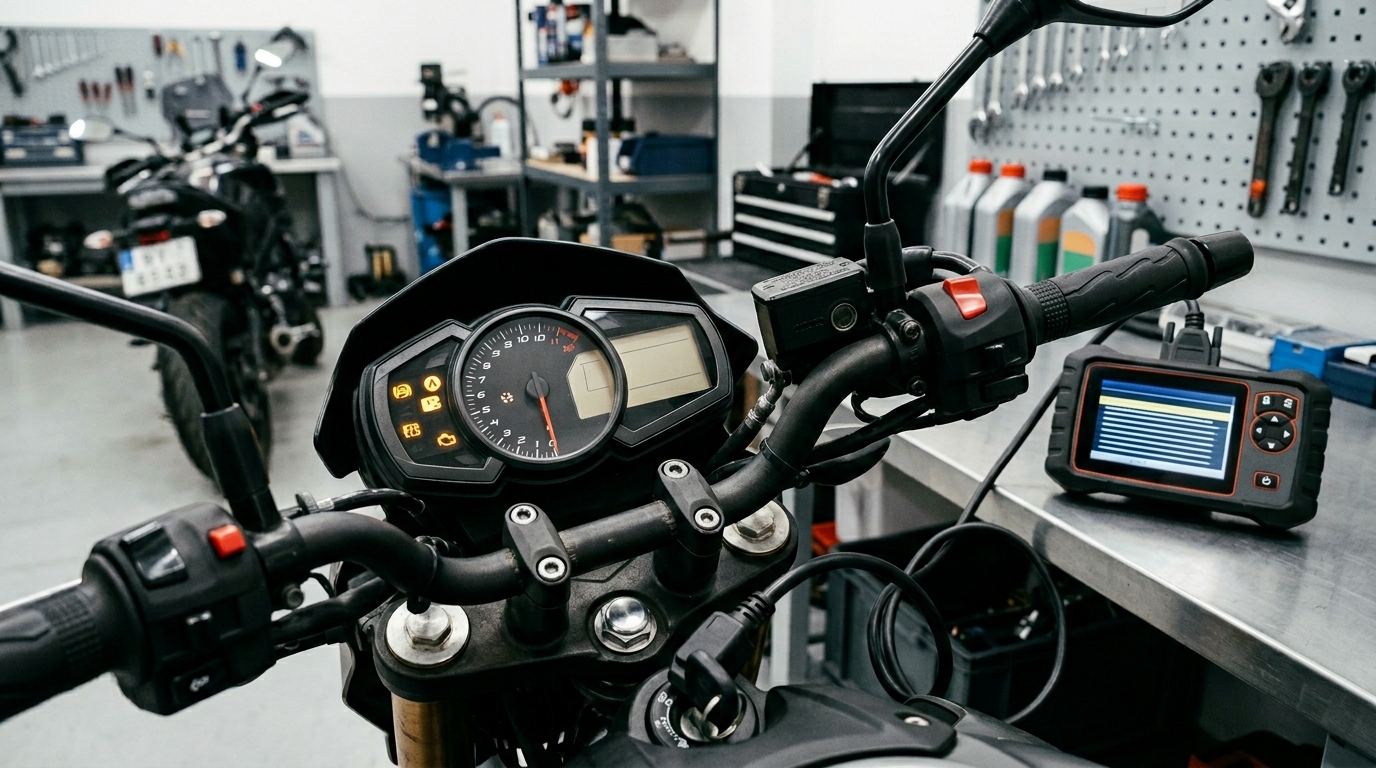
Many riders wait until a motorcycle completely fails before scheduling service. That is a mistake. Most problems give warning signs first. These signs may include hard starting, rough idle, poor throttle response, hesitation, stalling, misfires, overheating, weak charging, dim lights, random warning lights, ABS faults, traction control errors, poor fuel economy, or sudden loss of power.
Some symptoms feel minor at first. A bike may only hesitate at low RPM. The ABS light may turn on sometimes and then disappear. The engine may run fine when cold but poorly once hot. These intermittent issues can be frustrating because they do not always show up during a quick ride around the block. A proper diagnostic process looks at codes, live data, wiring, sensors, fuel delivery, battery health, charging output, and mechanical condition.
Warning lights are clues, not final answers
A check engine light or ABS light does not automatically tell you which part to replace. It tells you where the system detected a problem. For example, an oxygen sensor code may be caused by the sensor itself, but it may also be caused by an exhaust leak, wiring issue, fuel delivery problem, or poor tuning. An ABS warning light may point toward a wheel speed sensor, but the real issue could be wiring, tone ring damage, low voltage, or module communication.
This is where experience matters. A scanner can show the code, but a technician has to interpret the result. The best diagnostics combine electronic data with real mechanical inspection. That means checking connectors, grounds, fluids, tires, brakes, injectors, wiring, filters, spark plugs, and service history.
Intermittent electrical issues need careful testing
Electrical problems are some of the hardest motorcycle issues to diagnose. A loose connector, corroded ground, weak stator, failing regulator, damaged harness, or poor battery connection can create symptoms that come and go. Riders may describe the bike as “acting weird,” but the real problem may only appear under heat, vibration, load, or specific RPM conditions.
Smart diagnostics can help narrow the search. Voltage testing, continuity checks, charging system tests, scan data, and visual inspection can reveal problems before they become roadside failures. This matters even more for riders with extra accessories, lighting, race electronics, fuel controllers, or custom installations.
Why fuel injection and throttle response problems need data
Fuel injection has made motorcycles more reliable and more tunable, but it has also made diagnosis more technical. A motorcycle that runs lean, rich, flat, or jerky may have an injector issue, air leak, sensor problem, fuel pump weakness, throttle position problem, or incorrect map. Without data, it is easy to blame the wrong part.
Fuel injection tuning is especially important after modifications. Exhaust changes, intake upgrades, engine work, gearing changes, and racing setups can all affect how the bike responds. A motorcycle may start and run with a basic setup, but that does not mean it is optimized. Poor fueling can cause heat, hesitation, weak acceleration, poor mileage, or inconsistent throttle feel.
Sensor data helps separate tuning issues from mechanical problems
Good diagnostics help determine whether the motorcycle needs repair, tuning, or both. If the fuel injectors are dirty, a new map will not fully fix the problem. If the throttle position sensor is inconsistent, the bike may never feel smooth. If the air-fuel ratio is off after performance upgrades, the engine may need proper dyno tuning instead of random adjustments.
Clifford Cycles offers fuel injection tuning, Power Commander custom fuel maps, injector cleaning, matching, and testing. Those services are useful because they address both performance and reliability. A properly tuned motorcycle should respond cleanly, accelerate smoothly, and deliver power in a controlled way. Riders interested in power delivery should also review Choosing the Right Motorcycle Chain and Sprockets for Peak Performance, because gearing and fuel delivery work together to shape how a bike feels on the road or track.
ABS, Traction Control, Dyno Tuning, and the Future of Motorcycle Service
ABS and traction control are now common on many modern motorcycles. These systems can improve control, but they also add diagnostic complexity. ABS depends on wheel speed sensors, tone rings, brake components, wiring, control modules, and proper tire size. Traction control may rely on wheel speed, throttle position, engine speed, ride modes, and other data. If one input is wrong, the system may react poorly or disable itself.
The Motorcycle Safety Foundation explains that an anti-lock braking system helps maintain traction by preventing wheel lock as the tires approach the braking limit. Riders can read more from the official MSF resource here: Motorcycle Safety Foundation Anti-Lock Braking System Guide.
ABS and traction control problems can affect rider confidence
When ABS or traction control lights appear, riders should not ignore them. The bike may still run, but safety systems may be limited or disabled. A warning light can also indicate a deeper issue that affects braking or stability. If the problem appears after a tire change, wheel service, brake repair, or sensor replacement, the cause may involve sensor alignment, wiring, tone ring clearance, or incorrect installation.
Tire choice can also affect electronic systems. Some motorcycles are sensitive to tire size, wheel speed differences, and rolling diameter. That is why tire installation and diagnostics should not be treated as separate topics. Riders who recently replaced tires should also read Clifford Cycles Motorcycle Services to understand how tire changes, service work, dyno tuning, and setup support can work together.
Dyno tuning turns diagnostic data into real performance
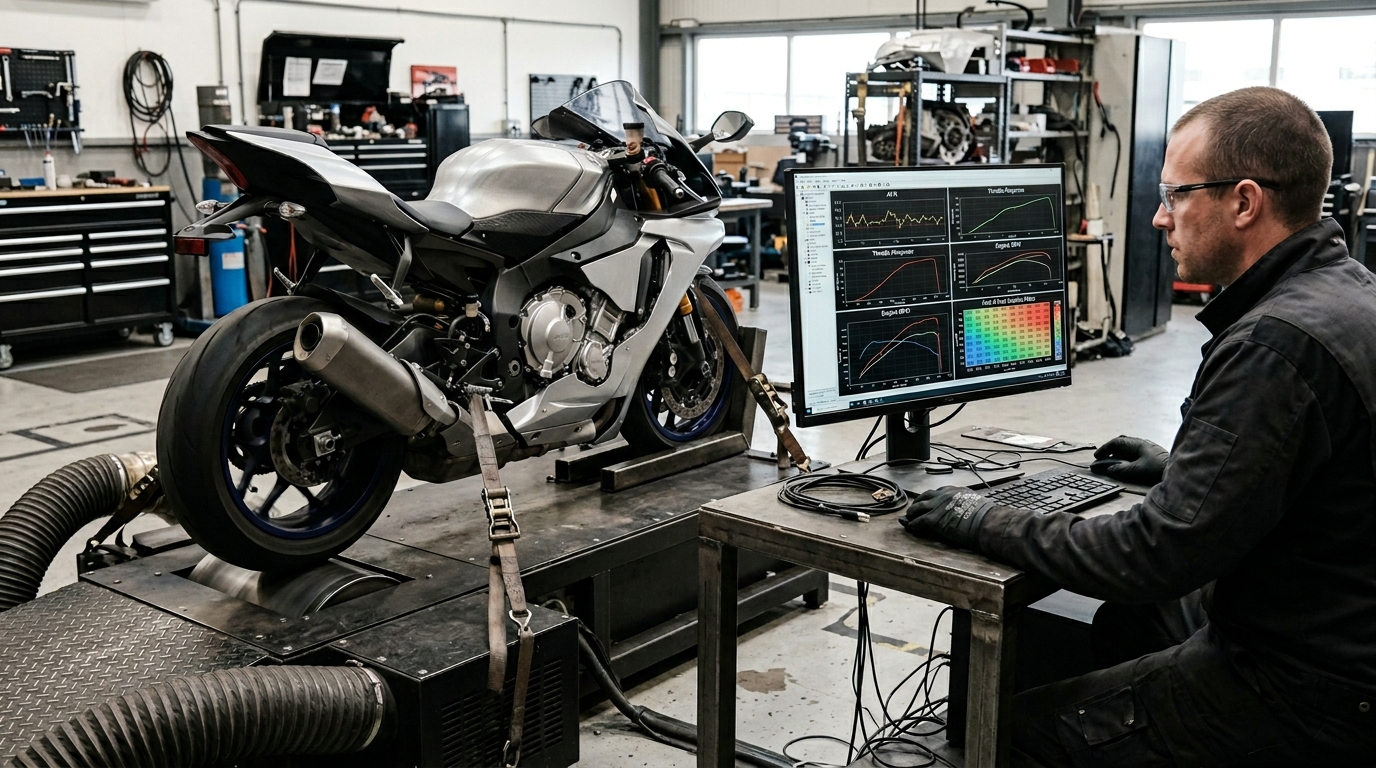
Diagnostics find problems. Dyno tuning shows how the motorcycle performs under controlled load. That is a big difference. A bike may feel strong on the street but show weak spots on the dyno. It may have uneven fueling, flat spots, poor throttle response, or inconsistent power delivery. Dyno testing helps reveal those issues clearly.
For performance riders, a dyno is not only about chasing peak horsepower. It is about rideability. Smooth throttle response, clean fueling, predictable acceleration, and reliable power matter more than a single big number. This is especially true for track riders and Micro Sprint racers where control, repeatability, and setup consistency are critical.
Smart motorcycle diagnostics also protect upgrades. Before investing in expensive parts, riders should know whether the bike is healthy enough to benefit from them. A motorcycle with weak compression, dirty injectors, poor charging, or worn drivetrain parts may not respond properly to performance upgrades. Fixing the foundation first is the smarter move.
Riders focused on efficiency and reduced friction may also want to read Ceramic Bearings vs. Steel Bearings. Bearing condition, drivetrain efficiency, tires, suspension, fueling, and engine health all affect how a motorcycle feels and performs.
In 2026, the best motorcycle service is not based on guesswork. It is based on data, testing, mechanical knowledge, and honest inspection. Whether your bike has a warning light, rough throttle response, ABS issue, electrical problem, or performance upgrade plan, smart diagnostics can save money and prevent bigger repairs.
Use smart motorcycle diagnostics as the first step before replacing parts blindly. A proper diagnosis helps riders make better decisions, keeps motorcycles safer, and gives performance builds a stronger foundation. For street riders, that means confidence. For track riders, that means consistency. For racers, that means every setup change starts with facts instead of assumptions.